


How to independently test the precision of a 3D welded table
Apr 27, 2026
Palik žinutę
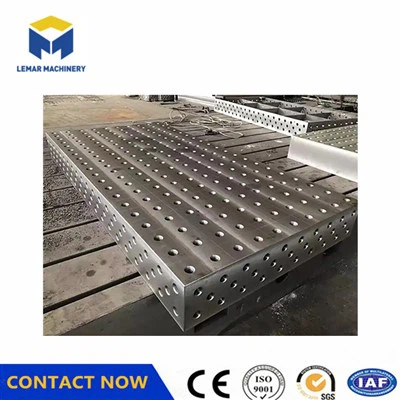
1. Flatness Inspection (using electronic level or bridge plate + dial indicator): Divide the platform into a 50mm × 50mm grid and measure point by point along the X/Y directions.
Use an electronic level (accuracy 0.01mm/m) to read the tilt value at each point and convert it to a height difference. The maximum deviation should be <= 0.08mm/m².
If using a bridge plate and dial indicator combination, move the measurement along the guide rail and record the runout. Mark any areas exceeding the tolerance.
2. Positioning Hole Accuracy Inspection (PC Pin + Dial Indicator): Select a standard φ28mm or φ16mm PC pin and insert it into the positioning hole, ensuring there is no significant looseness.
Fix the dial indicator to the bracket, with the probe contacting the side of the PC pin. Slowly rotate it one full turn and record the runout value. It should be <= ± 0.02mm.
Randomly inspect no fewer than 10 holes, prioritizing corners and the center to ensure overall consistency.
3. T-slot Straightness and Parallelism Check: Use a ruler and feeler gauge or a special inspection tool to slide along the T-slot and check the slot width and center distance.
The parallelism error should be controlled within ±0.03mm. The slot opening should be free of burrs and deformation, ensuring smooth slider operation.
4. Repeat Positioning Accuracy Verification (Standard Module + Height Gauge): Install standard squares, square boxes, etc., and use a height gauge and feeler gauge to check perpendicularity and fitting gaps.
After multiple disassembly and reassembly, remeasure. The positional deviation should be <=±0.1mm, and the joint gap <=0.03mm.
A standard workpiece of known dimensions can be used for trial clamping to verify consistency in each clamping.
5. Environmental and Operational Precautions: Before testing, ensure the work surface is clean and free of oil, metal shavings, etc., to avoid impurities affecting the measurement results.
Avoid operation in environments with large temperature differences (>10℃) or strong vibration to prevent thermal expansion and contraction or interference.
All measuring tools must be calibrated to ensure data reliability.
Siųsti užklausą